How to Scale a Recipe Up or Down
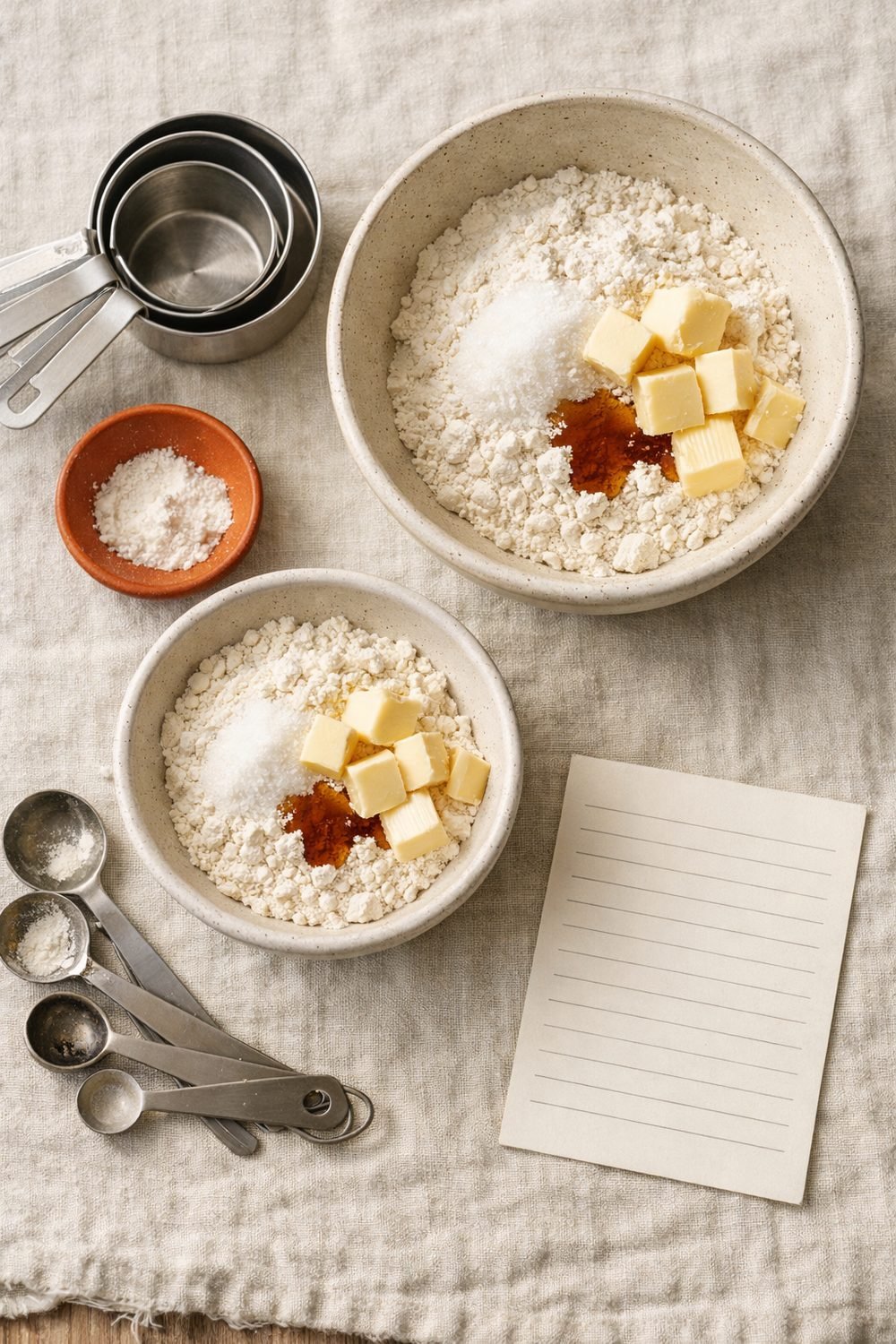
Learning to scale a recipe sounds harder than it is. Most of the time it's just careful math, plus a few small judgment calls that the math can't make for you.
Scaling mistakes can get messy fast. The first time I doubled a soup recipe for a family dinner, I doubled everything, including the salt and the chili flakes. It was edible. Barely. An over-seasoned dish can leave people reaching for glass after glass of water. Whether you scale a recipe up for a crowd or down for one on a weeknight, a simple process holds up.
Here's how I do it, step by step, with the small tips that save you from my soup moment.
Short on time? Our top picks: OXO Good Grips Food Scale, Escali Primo Digital Scale, Pyrex Glass Measuring Cups and Nordic Ware Half Sheet Pan. See all picks
What you need
- The original recipe, printed or written out so you can mark it up
- A pencil (not a pen, you'll change your mind)
- A calculator or the one on your phone
- A kitchen scale, if you have one. It makes everything easier, though you can get by without it.
- Measuring cups and spoons
- A ruler or tape measure for checking pan sizes
- A notebook or recipe card for writing down what worked
Step 1: Find your scaling number with a simple recipe calculator
Every scaled recipe starts with one number, and you don't need a fancy recipe converter to find it. This is called the scaling number, though some people call it the conversion factor. You get it by dividing the servings you want by the servings the recipe makes.
Say a recipe serves 4 and you need to feed 6. Divide 6 by 4 and you get 1.5. That's your number. Every ingredient will be multiplied by 1.5.
Going smaller works the same way. If a recipe serves 8 and you only want 2, divide 2 by 8. You get 0.25, which means you'll use a quarter of everything.
Write that number at the top of the recipe in big pencil. It helps to circle yours. It sounds silly, but halfway through cooking, with flour on your hands, you will forget it.
Tip: If the recipe doesn't list servings, use something else you can count, like the number of cookies, muffins or the pan size. A recipe that makes 24 cookies scaled to 36 cookies gives you the same 1.5.
Step 2: Multiply each ingredient, one at a time, like a recipe scaler would
Go down the list and multiply every amount by your scaling number. Do it line by line and write the new amount right next to the old one. Don't try to do it in your head while you cook. That's where mistakes sneak in.
Some amounts will come out clean. Two cups of flour times 1.5 is three cups. Easy.
Others get awkward. A third of a cup times 1.5 is half a cup, which is fine, but three-quarters of a teaspoon times 0.25 is a tiny, weird amount. This is where a scale really helps. If the recipe gives weights in grams, multiplying is simple and you never have to wrestle with fractions of a cup.
If you're working in cups and spoons, it helps to know a few swaps:
- 3 teaspoons = 1 tablespoon
- 4 tablespoons = 1/4 cup
- 16 tablespoons = 1 cup
So if your math says 1.5 tablespoons, that's 1 tablespoon plus 1.5 teaspoons. If it says 6 tablespoons, you can just use a quarter cup plus 2 tablespoons.
Tip: Eggs are the classic headache. If you need 1.5 eggs, crack 2 eggs into a bowl, beat them, and use about three-quarters of it. Or weigh the beaten egg and use the right portion. Save the rest for scrambled eggs in the morning.
Honestly, if you scale recipes often, this is the step where a worksheet saves you time. That's why I made the Recipe Scaler and Meal-Prep Planner, a simple printable recipe scaler you'll find below this post. It's a simple sheet with columns for the original amount, your number and the new amount. You don't need it, but I like having it on the fridge.
Step 3: Match the pan to the new amount when you scale a recipe
This is the step most people skip, and it's the reason a lot of scaled bakes go wrong. If you double a cake batter and pour it into the same pan, you'll get something thick and raw in the middle, and probably some batter on the oven floor.
What you want is a pan that holds the new amount at about the same depth as the original. To compare pans, figure out the area of the bottom.
- For square or rectangle pans, multiply length by width. An 8-inch square pan is 8 times 8, which is 64 square inches. A 9 by 13 pan is 117 square inches.
- For round pans, multiply half the width by itself, then by 3.14. A 9-inch round is about 4.5 times 4.5 times 3.14, which comes out near 64 square inches.
That math tells you something handy. An 8-inch square and a 9-inch round hold about the same amount. And a 9 by 13 holds a little less than two 8-inch squares. So if you double an 8-inch brownie recipe, a 9 by 13 will be close, just a touch thicker.
Going down? Half of a 9 by 13 recipe fits nicely in an 8-inch square or a 9-inch round.
For soups, stews and sauces, pan size is less fussy. Just make sure your pot is big enough that the food isn't climbing up to the rim. A doubled chili in a pot that's too small is a stovetop mess waiting to happen.
Tip: Measure your pans across the inside, not the outside, and write the size on a piece of tape on the bottom. You'll stop guessing every time.
Step 4: Rethink the cooking time and heat for your recipe
Here's the part math can't do for you. Cooking time doesn't scale the same way ingredients do. If you double a recipe, it won't take twice as long. If you halve it, it won't take half the time either.
What really changes the time is the thickness of the food and how crowded the pan is. A deeper cake takes longer to bake through. A thinner one finishes faster. A big pot of soup takes longer to come to a simmer, but once it's simmering, the cooking time is often similar.
A simple rule works best. Keep the oven temperature the same as the recipe says, and start checking earlier than you think you need to when scaling down, and keep checking past the listed time when scaling up. Use the clues the recipe gives you. A toothpick that comes out clean. Edges pulling away from the pan. Vegetables that are tender when you poke them.
Roasting is a good example. If you double roasted vegetables and pile them onto one tray, they steam instead of browning. Use two trays, like a pair of Nordic Ware Half Sheet Pan trays, instead. Same with browning meat. Work in batches so the pan stays hot.
Tip: Set a timer for about two-thirds of the original time, then check. It's much easier to add five minutes than to rescue something burnt.
Step 5: Go easy on salt, spices and leavening
This is the soup lesson. Strong flavors don't always need the full multiplied amount, especially when you're scaling up a lot. Salt, chili, garlic, cloves, cayenne and strong herbs can get loud fast.
When I scale up, I add about three-quarters of the multiplied amount of salt and spices to start. Then I taste near the end and add more if it needs it. You can always add. You can't take out.
When scaling down, tiny amounts get tricky. A "pinch" of something times 0.25 is basically a few grains. You can just use a small pinch and taste.
Baking powder and baking soda are a little different. For modest changes, like halving or doubling, multiplying them normally usually works fine. For very large batches, some bakers find the result rises oddly or tastes a bit off, and the advice I've seen is to make several smaller batches instead of one giant one. Honestly, that's what I do for anything bigger than a double batch of baked goods. It's less stressful.
Tip: Taste at the halfway point and again at the end. Write down how much seasoning you actually ended up using, not just what the math said.
Quick side note: if you like testing recipes in small batches, you can grab my Free 3 Soup Recipe Cards by joining the email list, and they're a great place to practice scaling since soup is so forgiving.
Step 6: Write down what you did
It can feel like a hassle. Nobody wants to do homework after dinner. But this is the step that turns a one-time win into something you can repeat.
Right after you cook, while it's fresh, write the new amounts on the recipe card. Add notes about the pan you used, how long it really took, and whether the seasoning needed tweaking. Mine look like this: "Made 1.5x. 9x13 pan. 38 min, not 30. Salt was fine at 3/4. Kids wanted more cheese."
Next time, you'll skip all the math and just cook.
If you're scaling recipes because you're cooking for the week, it can help to plan those meals ahead too. The Weekly Meal Planner and Grocery List Pack below this post can help you keep track of which recipes you're making bigger and what you need to buy.
Tip: Keep scaled versions of your favorites side by side. A "for two" card and a "for a crowd" card for the same dish is surprisingly handy.
Troubleshooting
My scaled cake sank in the middle
Usually this means the pan was too small and the batter was too deep, or it came out of the oven before the center was set. Next time, check your pan area against the original and give it more time, testing the middle with a toothpick.
The edges burned but the center was raw
That's another deep-pan problem. Try a wider pan so the batter sits thinner. If you can't, lower the oven a little and bake longer, and you can lay a sheet of foil loosely over the top if the outside is browning too fast.
My halved recipe dried out
Small batches lose moisture faster, especially in a pan that's too big. Use a smaller pan or dish, and start checking for doneness much earlier than the original time. For stovetop dishes, a lid helps.
The flavor tastes flat after doubling
You probably held back on salt or acid, which is the safe way to go. Add a little more salt, a squeeze of lemon or a splash of vinegar, and taste again. That small bit of acid wakes things up more than you'd expect.
Everything is too salty or spicy
For soups and stews, you can add more of the unseasoned base, like broth, water, beans or potatoes, to spread it out. A spoon of plain yogurt or sour cream on top can calm the heat when serving. For baked goods, there's not much to fix, so just note it for next time.
Tools that make scaling easier
You can scale a recipe with just a pencil and a calculator, but a few tools take the fiddly parts off your plate. Here are some well-known options that fit the steps above.
OXO Good Grips Food Scale
Suits anyone who wants to multiply grams instead of wrestling with fractions of a cup. Check the maximum weight it can hold and whether the display is easy to read around a big mixing bowl.
Escali Primo Digital Scale
A good fit for home bakers who want a simple, compact scale for small and large batches. Check that it has a tare function and a unit switch between grams and ounces.
Pyrex Glass Measuring Cups
Handy for liquids when you are scaling soups, sauces and batters. Check the size of the cup against your new amounts so you are not measuring in many small rounds.
Nordic Ware Half Sheet Pan
Useful when doubling roasted vegetables, because a second tray keeps food browning instead of steaming. Check that it fits your oven, and whether you want to own two of them.
Lodge Dutch Oven
Suits cooks who scale up soups, stews and chili for a crowd. Check the capacity before you buy, and remember that enameled and bare cast iron care differently.
Paprika Recipe Manager
A recipe app for people who save lots of recipes and want to adjust servings and keep notes in one place. Check which devices it runs on and whether you want to sync it across them.
King Arthur Baking Pans
Worth a look if you bake often and want pans in the sizes you need for scaling cakes and brownies. Check the exact inside dimensions against your recipe before ordering.
Check current plans and prices on each brand's own site.
FAQ
Can I scale any recipe with an online recipe scaler?
Most cooking recipes, like soups, stews, sauces and casseroles, scale up and down really well. Baking is pickier, and things like bread, delicate cakes and candy can behave differently in big batches. When in doubt, make two normal batches instead of one huge one.
Do I need a kitchen scale to scale a recipe?
No, but it helps a lot. Weights are easy to multiply, and you skip all the fiddly fractions of cups and spoons. If you bake often, it's one of the few tools I think is worth having.
Should I change the oven temperature when I scale?
In most cases, keep the temperature the same and adjust the time instead. The exception is when a deep pan is browning too fast on the outside, where a small drop in heat with a longer bake can help.
What about yeast in bread recipes?
For a simple double or half, many home bakers multiply yeast normally and it works. For bigger changes, rising times can shift, so watch the dough rather than the clock. If a bread recipe has its own scaling notes, follow those first.
Your next step
Pick one recipe you make often and scale a recipe this week, even just in half, so you can practice with low stakes. If you'd like something easy to start with, join the email list and grab the Free 3 Soup Recipe Cards. Soup is the most forgiving thing to scale, and you'll get a feel for the math fast. After that, take a look at the Recipe Scaler and Meal-Prep Planner and the Weekly Meal Planner and Grocery List Pack below this post if you want a tidy place to keep your numbers and notes.
Printables and tools that can help
Recipe Scaler and Meal-Prep Planner
A browser tool where you scale a recipe up or down and plan meal-prep batches. Your data stays in your...
See detailsWeekly Meal Planner and Grocery List Pack
Printable weekly meal planner pages and grocery...
See details