Soup Recipe Cards: How to Write Your Own
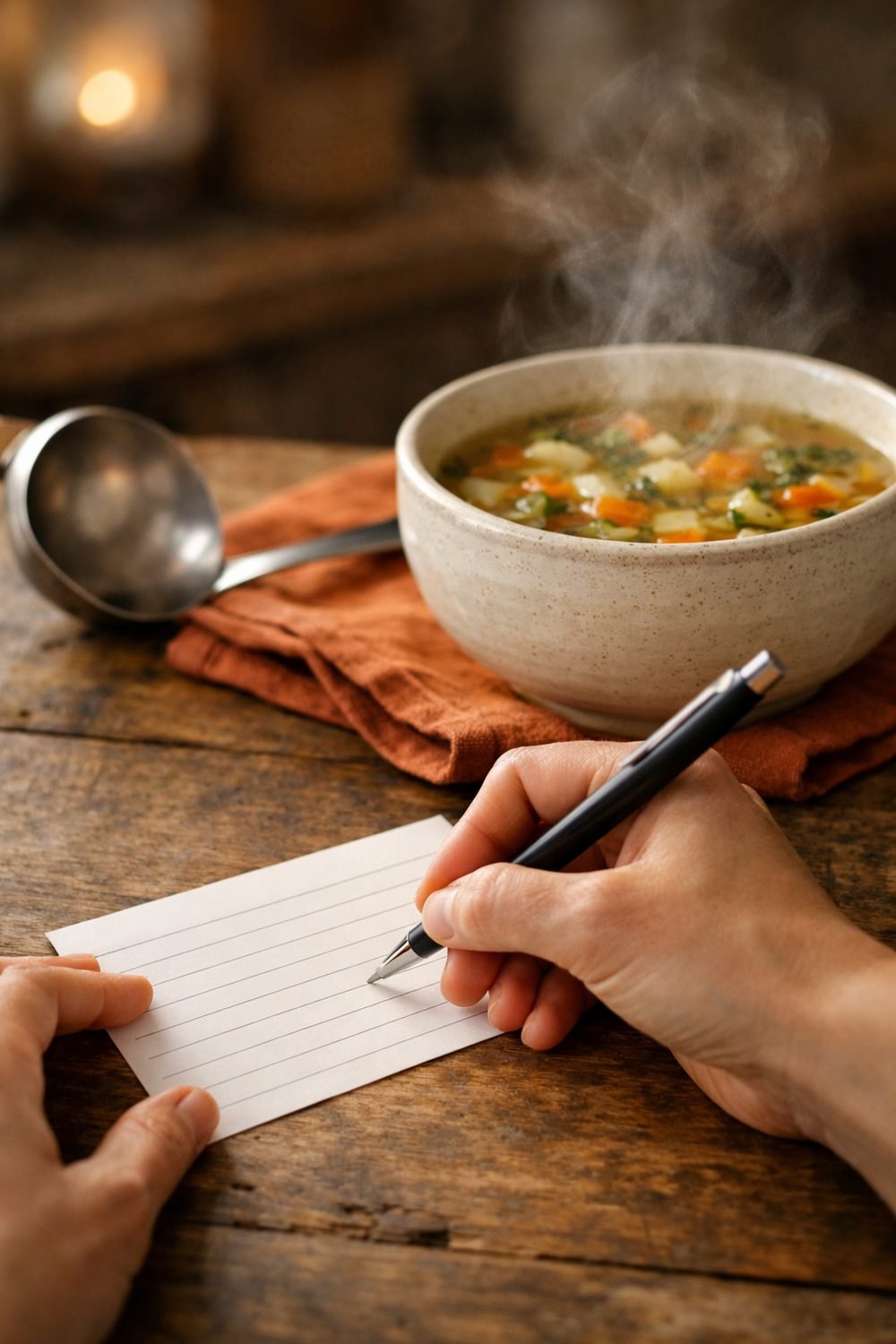
A kitchen drawer can easily fill up with soup "recipes." A sticky note that says "lentil, cumin, lemon at end." The back of an envelope with a relative's potato leek soup, half of it smudged with butter. A printout from a site I couldn't find again. When I wanted to make something, I'd dig through all of it and still end up guessing.
Writing your own soup recipe cards fixes that, and a simple soup recipe cards template can help. Not fancy ones. Just clear cards I could read with one hand while stirring with the other. Soup is a good place to start, too, because most soups forgive you. You can adjust as you go, and the card becomes a record of what actually worked in your pot, on your stove.
Here's how to write yours, step by step, plus common mistakes so you can skip them.
Short on time? Our top picks: Pilot G2 gel pens, Sharpie fine point permanent markers, Staples index cards and Avery printable index cards. See all picks
What you need
- Blank recipe cards, such as plain Staples index cards (soup recipe cards 4x6 inches are my favorite size; 3x5 feels cramped for soup)
- A pen that won't smear, such as a fine-tip Sharpie permanent marker or a Pilot G2 gel pen that's had time to dry
- The soup you want to record, either in your head or, better, on the stove right now
- A scrap piece of paper for a rough draft
- A measuring cup and spoons, if you usually cook by eye and want real amounts
- A box, binder, or folder to keep the finished cards together
That's it. You don't need a label maker or matching stickers. Those are nice if you enjoy them, but they're not what makes a card useful.
Step 1: Give the soup a clear, honest title
Write the name across the top in big letters. Make it something you'd actually search for in your head. "Soup #4" means nothing in six months. "Creamy Tomato Soup with Basil" tells you exactly what you're getting.
It also helps to add a tiny line under the title saying where the recipe came from. "From Mom, winter 2019" or "Adapted from a library cookbook." It's a small thing, but those little notes are the part I end up loving most when I flip through old cards.
Tip: If the soup has a nickname in your house, use it. We call one recipe "Snow Day Chicken Soup," and that's what's on the card. Nobody in a family would necessarily look for "Chicken and Rice Soup."
Step 2: Write a short "what is it" line
Right under the title, add one sentence about the soup. Is it brothy or thick? Spicy? Good for freezing? Does it need a crusty bread on the side?
This sounds extra, but it saves you on busy nights. You can glance at five cards and know in seconds which one fits what you have and how you feel. Something like "Thick, mild, freezes well, kids like it" does the job.
Tip: Note how many servings it makes and how big your pot needs to be. It's easy to start a soup that overflows a medium pot halfway through. Now my cards say "use the big pot" when it matters.
Step 3: List the ingredients on your soup recipe cards with real amounts
This is where most homemade cards fall apart. Mine did. "Some onion, a few carrots, broth" is fine if you made the soup yesterday. It's useless a year later.
Write each ingredient on its own line, with an amount and a form. "1 large yellow onion, diced." "2 carrots, sliced thin." "6 cups chicken or vegetable broth." If you cook by eye, make the soup once with measuring cups nearby and write down what you actually use. It feels fussy the first time. It's worth it.
List the ingredients in the order you'll use them. When your hands are busy, you'll want to read straight down the list without hunting.
Tip: For salt and spices, write a starting amount and add "to taste." Broths vary a lot in saltiness, so I'd rather the card tell me to start low and check than promise a number that might be too much.
Step 4: Break the method into short, numbered steps
Keep each step to one or two sentences. One action per step works best. "Heat oil in pot over medium heat. Add onion and cook until soft, about 5 minutes." Then the next step.
Don't write a paragraph. It's tempting, especially if you're used to telling the recipe out loud. But when the onions are sizzling and you look down at the card, a wall of text is hard to find your place in.
Include the signs you watch for, not just the times. "Cook until the potatoes break easily with a fork" is more helpful than "cook 20 minutes," because stoves and pots are all different. Put both when you can.
Tip: Write the rough draft on scrap paper first, then copy it neatly onto the card. A first try at any card will usually have crossed-out words and arrows. The scrap paper takes the mess so the card doesn't have to.
If you'd like to see how I lay out a finished card before you write your own, my Free 3 Soup Recipe Cards download is yours when you join the email list.
Step 5: Add prep time and cook time
Put two small times near the top of the card: how long to chop and get ready, and how long it's on the stove. Some people add a total time too. It's easy to just add them up in your head.
Be honest here. If it takes you 25 minutes to chop everything, write 25, not the 10 a cookbook might claim. The card is for you. It should match your kitchen and your speed.
For soups that taste better after resting, or that need beans soaked overnight, write that clearly near the top. Finding out at 5 p.m. that your beans needed to soak since this morning is not fun. It's an easy mistake to make. We had grilled cheese.
Tip: If you make a soup in a slow cooker or pressure cooker sometimes, add a separate small line for that time instead of writing a whole new card.
Step 6: Leave room for notes, and actually use it
Save the bottom or the back of the card for notes. This is honestly the most useful part, and the part store-bought recipes never have.
Write what you changed. "Used half the garlic, better." "Added spinach at the end, nice." "Too thin, try one less cup of broth next time." Date the notes if you can. Over a few batches, the card turns into your own version of the soup, tuned to how your family likes it.
You can also jot down what to serve with it and whether it froze well. Those little things answer the questions I always forget the answer to.
Tip: Use a different color pen for notes. It makes it easy to tell the original recipe from your changes at a glance.
Step 7: Store your soup recipe cards set where you'll use them
A card you can't find isn't much better than a sticky note. Pick one home for all of them and keep it near where you cook.
A simple recipe box works well. You can sort cards by type: brothy soups, creamy soups, bean soups, and "company soups" for when people come over. You might prefer sorting by season or by main ingredient. There's no wrong way, as long as it makes sense to you.
Soup cards get splattered. It's the nature of soup. Clear plastic sleeves help a lot, and you can slide a card into one and prop it up while you cook. Some people laminate their favorites. Sleeves are often easier, since you can still pull the card out to add notes.
If you'd rather start with a printable set that already has a layout and spaces for times and notes, the Soup Season Recipe Card Pack below this post is what we made for exactly that. And if you like keeping everything in one book instead of loose cards, the Home Cook's Kitchen Journal and Recipe Log, also below, holds recipes along with notes on what you've tried.
Tip: Keep a few blank cards at the front of your box. When you make something new and good, you'll write it down right away instead of telling yourself you'll remember. You won't. It's best not to.
Troubleshooting
My card is too crowded to read
Soup recipes can run long. Use both sides of the card, with ingredients on the front and steps on the back. Or move to a bigger card size. Writing smaller to squeeze it all in is the trap I'd skip, because you'll be squinting over a hot pot.
I don't know the amounts because I never measure
Make the soup once and measure as you go, even roughly. Pour the broth into a measuring cup before it goes in the pot. Count the carrots. You don't have to be exact forever, but the card needs a starting point.
The soup didn't turn out the same as last time
Check your notes against what you did. Often it's a different broth, a bigger onion, or cooking a little hotter. Write down what was different. After a couple of tries, the pattern usually shows up.
My ink smudged when the card got wet
Some pens run the second steam hits them. Test your pen on a scrap card, let it dry, and dab it with a damp cloth. If it holds up, use it. Plastic sleeves solve most of this anyway.
I have too many cards and can't find anything
Go through them once and pull any you haven't made in a long time or didn't love. Keep those in a separate "maybe" pile at the back. A smaller box of soups you actually make is more useful than a huge one.
Our top picks for soup recipe cards
You don't need much to make cards that last, but a few good supplies make the job easier. Here are tools and products that fit the steps above.
Pilot G2 gel pens
A familiar gel pen that suits anyone who writes cards by hand and wants smooth, easy notes. Check whether the ink is truly dry before it meets steam or a splash, and test it on a scrap card first.
Sharpie fine point permanent markers
A good fit if you want bold titles that are easy to read from a few steps back. Check for bleed-through on thinner cards, especially if you plan to write on both sides.
Staples index cards
A simple, easy-to-find source of plain ruled or blank cards in common sizes. Check the card size and paper weight before you buy, since soup lists often need the larger size.
Avery printable index cards
Suits anyone who would rather type and print cards than write them by hand. Check that your home printer can handle the card size and the template you pick.
Rubbermaid Brilliance food storage containers
Handy for the soups you freeze, so you can label a container to match its card. Check that the lid style and size fit your freezer and your usual batch.
Paprika recipe manager app
A good pick if you like keeping a digital copy alongside paper cards. Check which devices you want to use it on and how its sync and purchase options work before committing.
Evernote
Suits people who want one searchable place for notes, photos and scanned cards. Check how much storage and device syncing you need, since plans differ.
Check current plans and prices on each brand's own site before you buy.
FAQ
What size are the best soup recipe cards 4x6 or 3x5?
4x6 inch cards work well for soup, because the ingredient lists tend to run long. A 3x5 card works for simple soups, but you'll likely need the back. Pick whatever fits your box and is easy to read from a little distance.
Should I write cards by hand or type them?
Either is fine, and typed cards can be saved as a PDF to print again later. Handwritten cards feel personal and are easy to add notes to later. Typed cards are neater and easy to reprint, and Avery printable index cards are one option for that, so do what you'll actually keep up with.
Can I write a card for a recipe I got from a cookbook?
For your own kitchen use, plenty of people do, and I'd note where it came from on the card. Write it in your own words with your own changes, which makes it more useful anyway. If you plan to share or sell cards, check the rules on that yourself first.
How do I keep cards clean while cooking?
Slide them into clear plastic sleeves or prop them up away from the stove. A small stand or a clip on the fridge keeps them off the counter where spills happen. Wipe the sleeve after, and the card stays fine.
Your next step
Pick one soup you make often, the one you could almost make in your sleep, and write its card tonight. That's the easiest place to start, and once you've done one, the rest come quicker. If you want a head start, grab the Free 3 Soup Recipe Cards by joining the email list, so you can see a finished layout and cook from them right away. Then, if you'd like more cards or a journal to keep it all in one place, take a look at the Soup Season Recipe Card Pack and the Home Cook's Kitchen Journal and Recipe Log below this post.
Printables and tools that can help
Home Cook's Kitchen Journal and Recipe Log
A 100-page journal for recipes, notes and what you cooked, in your own...
See details